
Our Certifications
Click the image to view.


Product Introduction
Magnesium + ashwagandha gummies offer supplement brands a focused product direction for relaxation, sleep support, and daily stress management. Compared with capsules, tablets, and powders, the gummy format provides a more approachable daily-use experience, making it easier for brands to connect functional ingredients with real consumer routines. At SUCOTOND, this product direction is treated as a complex formulation system rather than a simple ingredient combination. Magnesium salts can bring bitterness and metallic notes, while ashwagandha extract may add herbal aftertaste and compatibility pressure. A successful gummy product requires careful control of flavor masking, texture, active loading, serving design, and formula stability. We support private label magnesium + ashwagandha gummy projects with attention to dose-to-format balance, batch consistency, packaging compatibility, quality documentation, and sample-to-production alignment. The goal is to help brands develop a marketable, consumer-friendly, and manufacturable gummy supplement for long-term commercial use.
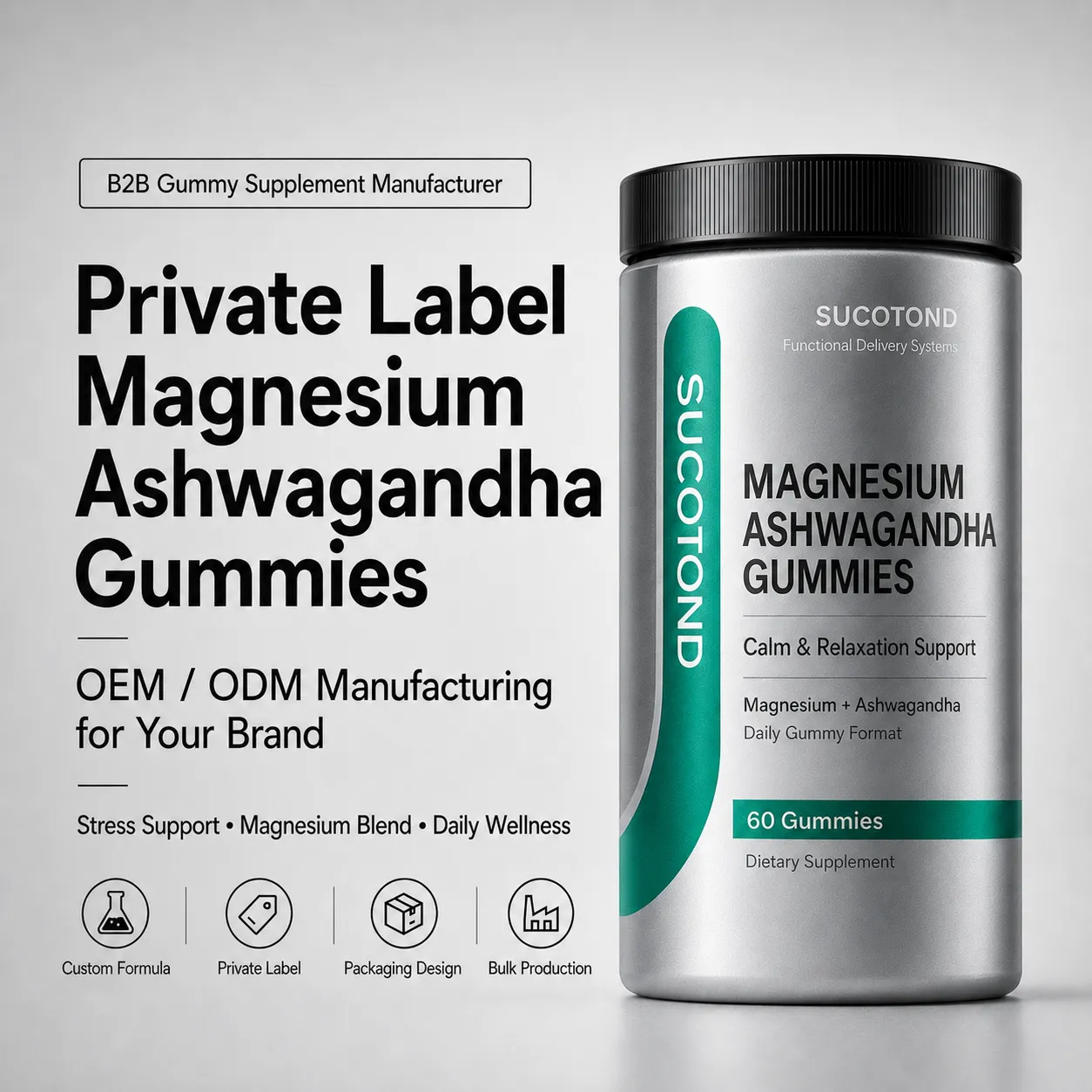
Magnesium Ashwagandha Gummies
Magnesium Ashwagandha Gummies designed for relaxation and stress support supplement brands seeking customizable formulas, private label packaging, and stable gummy manufacturing.
Product Snapshot
Customization Support
- Magnesium and ashwagandha formula direction support
- Relaxation, calm, or stress support positioning
- Flavor, sweetness, color, and texture customization
- Private label bottle, pouch, and label packaging
MOQ from 5,000 bottles · Samples in 7–14 days · GMP / HACCP certified
Why Private Label Magnesium + Ashwagandha Gummies Matter

Composite functional direction value
Magnesium and South African passionflower have complementary expressions in the areas of relaxation, sleep support, and daily stress management. Magnesium focuses on nerve and muscle relaxation, while South African passionflower focuses on stress regulation and sleep support. When combined, they form a relaxation + stress management + sleep support composite functional direction. This direction is suitable for long-term use scenarios such as high-pressure workplaces, emotionally sensitive individuals, and those with sleep problems, and has continuous layout value.
Formulation value
Making magnesium + South African passionflower into soft candies mainly lies in combining functional requirements with daily usage experience. Compared to capsules, tablets, and powders, soft candies do not require mixing or swallowing, and are suitable for daily scenarios such as office work, commuting, and business trips. Their taste and chewing experience can reduce the psychological burden of supplements and help improve the convenience of daily use and long-term adherence.
Brand Differentiation Value
Magnesium + South African passionflower soft candies are not just the combination of two ingredients, but a more focused composite product expression centered around relaxation, stress management, and sleep support. The soft candy form is convenient to carry and suitable for daily consumption, and is more easily associated with scenarios such as bedtime relaxation, post-work stress relief, and daily stress management. Through scenario expression and a more friendly consumption form, a consumer-friendly format differentiation can be formed.
Key Challenges in Magnesium + Ashwagandha Gummies Manufacturing
Compatibility challenges of the formulation system
When the mineral system and the plant extract system coexist, the taste, stability, and process compatibility will become more complex. Magnesium salts may bring a bitter and metallic taste, and the South African passion fruit extract also has a herbal astringent flavor. When combined, it is prone to experiences such as a sweet front followed by bitterness, and a lingering astringent aftertaste. In terms of system stability, magnesium ions may interact with components such as polyphenols, flavonoids, and saponins in plants, leading to risks of color change, browning, or precipitation. In terms of process, minerals and plant extracts have differences in solubility and temperature resistance, and more detailed compounding design is required.
The challenge of balancing taste and flavor
The bitter and metallic taste of magnesium salts and the herbal flavor of South African passion fruit combined together do not simply add up; they are more likely to be amplified. A single sweet flavor or ordinary flavoring cannot fully cover these complex odors. Therefore, a stronger flavor system and masking logic are needed. By compounding sweet and sour flavors and adapting to the flavor design of different products, it is possible to minimize the unpleasant bitterness and herbal aftertaste while retaining the product perception of natural extracts.
Content and Formulation Balance Challenge
This composite direction should not only pursue high content figures. After increasing the total loading of magnesium and South African passion fruit, hard candies are prone to bitter,糊-like, chewing burden, and taste pressure; if the single particle is too large or the daily particle count is too high, it will also reduce the daily-use acceptance. Excess content may also damage the colloid system and increase the difficulty of mass production. Therefore, the single particle weight, the number of particles per serving, the taste, and manufacturing feasibility need to be balanced simultaneously.
Consistency and Scaling Challenges
The compounding system is more complex than a single component. Problems that are easily masked in the laboratory small-scale trial stage are more likely to be exposed in mass production. The laboratory pot is small, the operation time is short, and the temperature control is more precise; in mass production, the pot size increases, the cooling speed is different, and the continuous production time is longer, and personnel operation also brings differences. Plant extracts are significantly affected by heat and light, and magnesium ions may accelerate oxidation and color change. These factors accumulate and can lead to fluctuations in color, appearance, flavor, texture, and batch consistency.
Magnesium + Ashwagandha Gummies Specification & Dosage Variables
Content direction
The different content combinations of magnesium and South African passion fruit will affect the product positioning, target audience, and manufacturing feasibility. A high content leans more towards a strong functional positioning, suitable for people with clear needs for relaxation, sleep, or stress management, but the high total powder loading may affect the stability of the gel, taste, and batch performance. A medium or mild dosage is more suitable for daily relaxation and stress regulation scenarios, balancing effectiveness and experience. A low content has a less intense taste, but may require a higher consumption amount. The actual design needs to balance functionality, taste, process, and texture.
Grain weight
The weight of a single piece will affect the dosage capacity of each soft candy, the chewing experience, size, and packaging presentation. Large or heavy particles will increase the number of chews and the sense of heaviness; a single piece that is too light may make consumers feel that the portion is insufficient, which also limits the loading capacity of magnesium and South African passion fruit. The maximum customer acceptance was approximately 5 pieces per time, and 3 pieces were more suitable for acceptance, with each piece weighing 4-5g being more appropriate. On the packaging, the weight of a single piece also affects the first impression of consumers regarding the product's value and convenience.
Each particle quantity design
The design of the number of pieces per serving affects daily-use acceptance, label presentation, and actual usage pressure. Based on a single piece weight of 3-5g and a magnesium dose of 14%, and 3 soft candies could provide more than 1g of magnesium and more than 0.25g of South African passion fruit. Such a design can distribute the load of each single piece, reduce the taste pressure of each soft candy, and maintain a relatively clear per-serving expression and a lower consumption burden.
Dosage and formulation balance
Magnesium + South African passion fruit belong to a compound formula, with a total loading capacity higher than that of a single component. Therefore, a dose-to-format balance is more necessary. If the weight of a single piece is fixed but the dosage design is unreasonable, problems such as insufficient component loading, poor soft candy formation, or increased consumption burden may occur. Excessive compounding will make the single piece too large, reducing the willingness to consume daily. Reasonable distribution of dosage allows each soft candy to balance functional expression and daily adherence, which is more suitable for long-term product design than simply increasing the label number.
Magnesium + Ashwagandha Gummies Formula & System Considerations
Magnesium system and plant extract system
The combination of magnesium and South African passion fruit gummy candies is not simply a matter of adding simple ingredients together; it requires a systematic optimization of product design. Magnesium sources generally have a bitter and metallic taste, while the extract of South African passion fruit has a herbal astringent flavor. When combined, the taste pressure will increase, and sweet flavors alone may not be able to fully cover the unpleasantness. Both may also affect the gelation degree and color stability. In terms of the process, magnesium will affect the boiling conditions, and the South African passion fruit extract is more sensitive to heat, so the boiling, pouring, drying, and cooling processes all need to be adjusted accordingly. The formulation ratio, dosage, taste, and particle design jointly determine whether the product is more for daily health care or functional enhancement.
Basic sugar system
The basic sugar system will affect the taste, stability, and acceptance of such combined gummy candies. By using sugar alcohol systems, which have a relatively light sweetness and a lower water activity, which is conducive to maintaining the texture and batch consistency of the gummy candies. Ordinary sugar systems have natural sweetness but a high sugar content, which is not suitable for those who are on a sugar-reduction diet or have health sensitivities. Adding a high-fiber system can form a synergy with the combined gummy candies, increasing the expression of dietary fiber. The choice of sugar system is not only a matter of taste but also affects the daily consumption experience and product stability.
Colloidal system
Different colloid systems will affect the texture, transportation performance, and industrial compatibility of the combined functional gummy candies. Gelatin is not resistant to high temperatures and extrusion, which is not conducive to transportation and storage; pectin has a refreshing taste and is more suitable for plant or natural combination directions, and is also more in line with the health positioning of magnesium + South African passion fruit. However, it is more sensitive to pH and solids, and batch control is more complex. Starch gel has a relatively solid texture and is usually more suitable as an auxiliary gel. Mixed gels can combine the advantages of different gels to optimize elasticity, chewing sensation, and transportation tolerance, but require stronger process control.
Flavor system
The magnesium + South African passion fruit combined formula is more suitable for a refreshing and mild sweet flavor with a touch of natural fruit acid or herbal notes. Magnesium has a slight metallic taste, and South African passion fruit has a herbal astringent flavor. Appropriate fruits or mild sweet flavors can neutralize the unpleasant taste, making the gummy candy more smooth on the palate. The taste comfort is more sensitive during bedtime or relaxation scenarios, and overly stimulating or intense flavors can affect the experience. Gentle, natural flavors are more conducive to long-term adherence and also affect repeat purchases and word-of-mouth.
Color and surface treatment system
Magnesium + South African passion fruit itself leans towards a relaxing and soothing direction, and the color and surface treatment need to match this scenario. Too bright colors are likely to conflict with bedtime and relaxation scenarios, while low saturation, natural, and close to the raw material feeling colors are more likely to convey a sense of reassurance and supplement attributes. In terms of surface treatment, overly shiny or sticky will affect the texture; opening the bottle without sticking together, and single particles being easy to take can improve the usage experience. We usually use natural pigments such as curcumin, carotene, betacyanin, and natural fruit juices, but the stability of natural pigments still needs to be continuously monitored.
Manufacturing Fit for Magnesium + Ashwagandha Gummies
Adaptation from prototype development to mass production
The successful development of the compound formulation does not mean there is no risk for mass production. The laboratory small-scale trial has a small pot size, short operation time, and easier temperature control; while in mass production, the pot size is enlarged, the boiling and heating retention time is prolonged, and the pouring time is increased, making losses and fluctuations more likely to occur. The coexistence of minerals and plant extracts inherently increases the complexity of the process. Therefore, it is necessary to lock in the process window in advance, detect problems such as adhesion, uneven taste, and batch fluctuations as early as possible to avoid inconsistent performance between sample and mass production results.
Process compatibility
The mineral system and plant extract system jointly affect boiling, pouring, drying, and the overall process window. High content of mineral ions has a high intensity and may increase viscosity and shorten the operable time; plant extracts are more sensitive to temperature, and high temperatures may cause flavor changes or loss of activity. The compound system may also make the material flowability worse, causing pouring problems such as stringing and trailing. The hygroscopicity of minerals and the water-holding capacity of plant extracts will also delay drying. Therefore, manufacturing fit is more important than concept performance.
Reproducibility of production feasibility
The magnesium + South African passionflower compound system is more complex and is more sensitive to moisture, pH, and temperature. Therefore, special attention needs to be paid to repeatability, flavor stability, and long-term commercial output. Repeated verification of multiple batches can identify the sensitive points of the formula or process and reduce fluctuations caused by human and environmental factors. Stable flavor also helps to mask mineral metallic taste and plant astringency. For such compound gummies, competitiveness is not just about one batch being good, but each batch can consistently approach the same performance.
Magnesium + Ashwagandha Gummies Packaging Compatibility
Matching packaging form
For this type of compound candy, it is recommended to use bottles as the packaging for daily use. Bottles have better sealing and support properties, which can prevent the candies from sticking together or deforming, making them suitable for daily use scenarios. However, the use period of bottles is longer, and opening them multiple times increases the risk of air exposure and moisture absorption. Bags are more lightweight and can be used for small-sized trial packs or portable scenarios. The count logic should be designed around the daily usage amount and channel pricing to meet the intake needs of different groups of people.
Specifications match the display.
The size of individual pieces will affect the packaging form, visual texture, and consumer perception of the scenario. If the individual piece is too large, it will cause visual and chewing burden; if it is too small, it may seem insufficient in content and require eating more pieces, which is not convenient. The design of the portion size directly affects the daily consumption amount and label expression. A common practice is to use 2-3 pieces per portion, 60 pieces or 90 pieces per bottle, allowing consumers to quickly understand how long a bottle can last.
Long-term display and storage compatibility
The compounding system, surface condition, and product condition all affect packaging, transportation, and storage performance. Magnesium, plant extracts, and other functional raw materials have different hygroscopicity and stability; some are more prone to absorbing moisture and becoming soft, while others may have changes in taste. Surface conditions such as coating with sand, oil, or powder directly affect the adhesion and powder shedding performance. The softness, hardness, or elasticity of the product itself also affect whether it can withstand stacking, long-distance transportation, and changes in storage environment.
Quality & Verification in Magnesium + Ashwagandha Gummies Manufacturing
Content authenticity
Magnesium + South African Passiflora requires greater attention to the consistency between delivered content and label presentation. When consumers purchase these products, they usually have clear expectations regarding relaxation, sleep support, or stress management. If the label expression is strong but the actual delivered content or experience does not match, there is a tendency for a gap to occur. Magnesium has absorption differences, and the content of the active ingredients in South African Passiflora also affects the final performance. Therefore, aligning the label content with the actual experience makes it easier to build trust and achieve repeat purchases.
Batch consistency
This formulation direction must ensure both the delivery of active ingredients and the consistency of flavor, color, texture, and the overall eating experience. When consumers eat gummies, the first impression is often related to taste, hardness, and color and other sensory details. If there are significant variations in taste, color shade, or hardness across different batches, even if the active ingredients are present, consumers are likely to perceive the product as unstable. Therefore, batch consistency is crucial for building trust and long-term use.
Documents and verification support
Structured records, COA, testing protocols, and verification logic are important for the formulation product page. Structured records can document the source of raw materials, the ratio of ingredients, and process parameters, facilitating traceability and troubleshooting; the form of magnesium, the content of the active ingredients in South African Passiflora, etc., require real testing data support, and COA is an important proof; testing protocols can help control key indicators such as activity, moisture, and stability; verification logic is used to determine if the ratio is reasonable and if the dosage conforms to the logic of daily supplementation.
Manufacturing and label consistency
The final production must be consistent with the development goals, label direction, and customer expectations. During the development stage, the targets for active ingredients, taste, stability, etc. have been determined, and the label will form consumers' psychological expectations for relaxation support, stress management, or daily supplementation. If the flavor, texture, color, or experience of the production version differ significantly from the sample, even if the changes are minor, it is likely to be perceived as a change in the product, affecting trust and repeat purchases.
Consumer Experience in Magnesium + Ashwagandha Gummies
Taste and Acceptability
This type of compound candy should not be judged solely by the active ingredient number; its taste and daily-use acceptance should also be considered. The active ingredient number mainly represents the theoretical content and does not necessarily mean that consumers will consistently consume it every day. If the taste is good and the burden is low, users are more likely to form the habit of consuming it regularly every day; if the taste is heavy, has a strong herbal flavor, or has an unpleasant aftertaste, they may switch from regular consumption to only eating it when reminded. In this case, even if the formula has high activity, the actual long-term intake will be affected.
Relaxation scenarios and long-term use
Magnesium + South African Capsicum is more suitable for long-term daily use and for scenarios related to emotions and sleep, rather than single-point quick-acting expressions. Magnesium focuses on nerve relaxation and muscle relief, while South African Capsicum leans towards stress adaptation and emotional state support. The combination of the two is more suitable for scenarios that require continuous accumulation of stress management, emotional regulation, and sleep support. Candy does not need to be mixed with water and has no obvious supplementing feeling, which can reduce the burden of use and make it easier for users to psychologically accept and persist in using it every day.
Brandization and Terminal Performance
Magnesium + South African Capsicum belongs to the direction of emotional regulation and sleep support, and its characteristics are more focused on continuous supplementation rather than quick effectiveness. The candy form does not need to be mixed with water, has simple steps, a friendly taste experience, and can reduce the psychological burden of users. Such a form change will be reflected in the terminal performance: the product looks more relaxed and easier to persist with, and it is more likely to change the purchase intention from need to buy again to have already gotten used to eating it.
Frequently Asked Questions
Common questions about custom gummy supplement manufacturing, private label service, and production support.