
Product Test
Creatine Gummies Tested:Guidelines for Brand-Side Sample Screening
If you are developing creatine monohydrate gummies for your brand and comparing samples from multiple suppliers.
You may wonder how to assess the quality of these samples and avoid problems such as insufficient active ingredient content.
This article can help you understand the tests and use them to screen samples.
Are Creatine Gummies Legit?
First, let us establish one point: creatine monohydrate gummies are a reliable dosage form for taking creatine monohydrate. A daily intake of 3-5g of creatine monohydrate (NIH ODS) is enough to achieve the product's intended effect. They are not just a gimmick.
However, in the current market, some consumers and other groups do question the effectiveness of this product.
For example, in SuppCo's testing, 4 of the 6 creatine gummy products failed the content test. NOW's test results also found that 50% of the samples contained no creatine monohydrate.
To avoid discovering similar quality problems only after the goods arrive, we recommend using several tests during development to thoroughly check samples from each creatine gummies supplier and screen them quickly and accurately.
Creatine Gummies Tested
We understand that sending dozens of creatine gummy samples to a laboratory for testing would be costly and time-consuming.
We have therefore put together a sequence of tests that fits your brand's practical needs: from viewing samples, to receiving them, to laboratory testing. Each step can help you screen out low-quality products.
Appearance Testing
Appearance testing is a practical, low-cost starting point for creatine gummy testing.
Before receiving samples, you can assess their appearance through the manufacturer's website images, email attachments, video calls, and other channels.
Although this digital information cannot replace receiving physical samples, obvious visual defects can alert you to potential problems with the product.
Appearance checks include shape, transparency, color uniformity, surface smoothness, water separation, cracks, and other defects.
Shape:
The shape of a creatine gummy tells you little about its quality, because it can be highly customized through the mold.
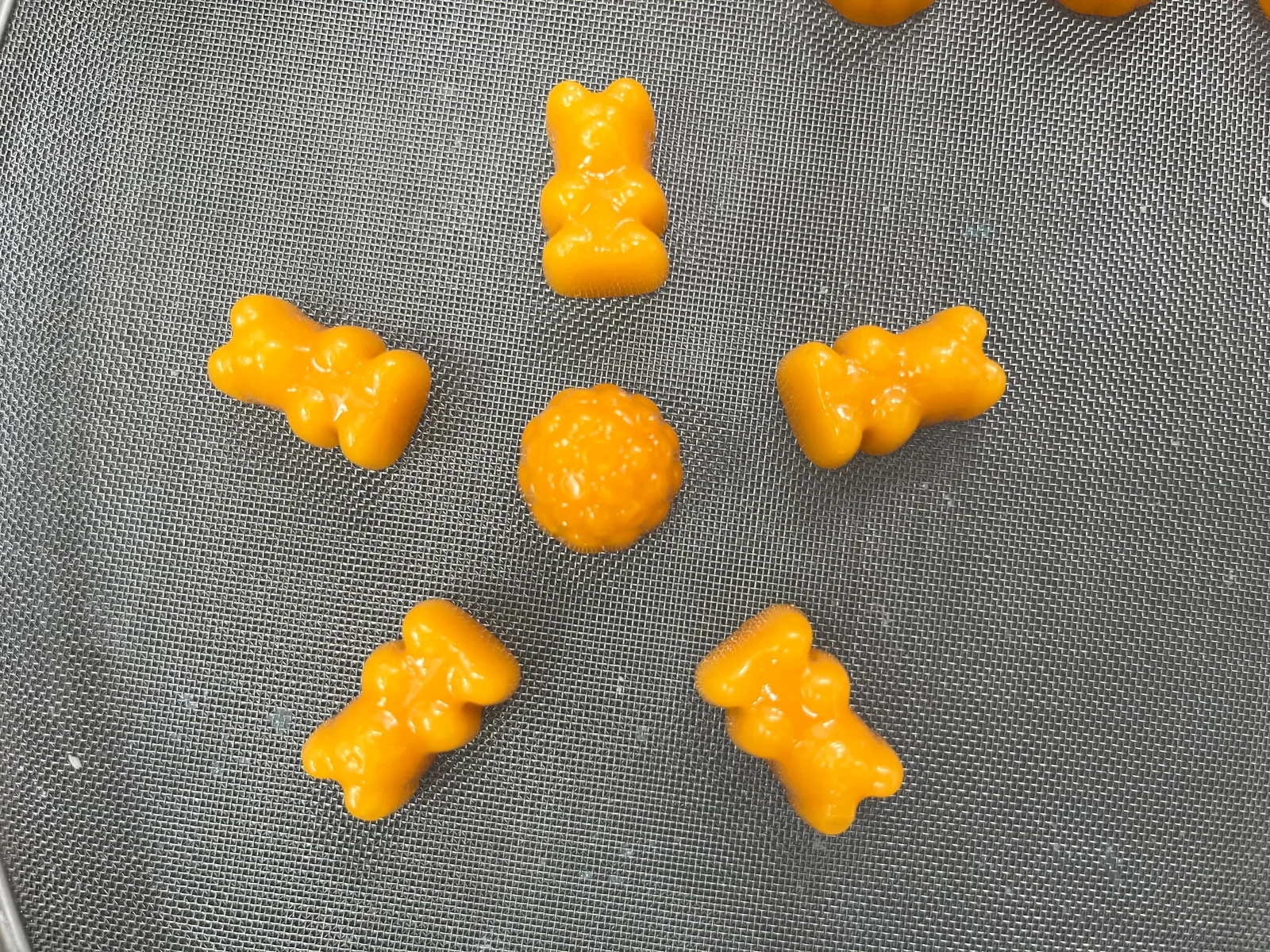
For certain shapes, especially creatine gummy bears, focus on whether the bears appear hunched over.
Unlike other geometric shapes, bears have large heads and bodies with relatively narrow necks. Rough handling during powder coating and drying, or insufficient resilience due to the formulation, can make the bears' heads droop and their backs hunch, affecting your product's appearance.
Transparency:
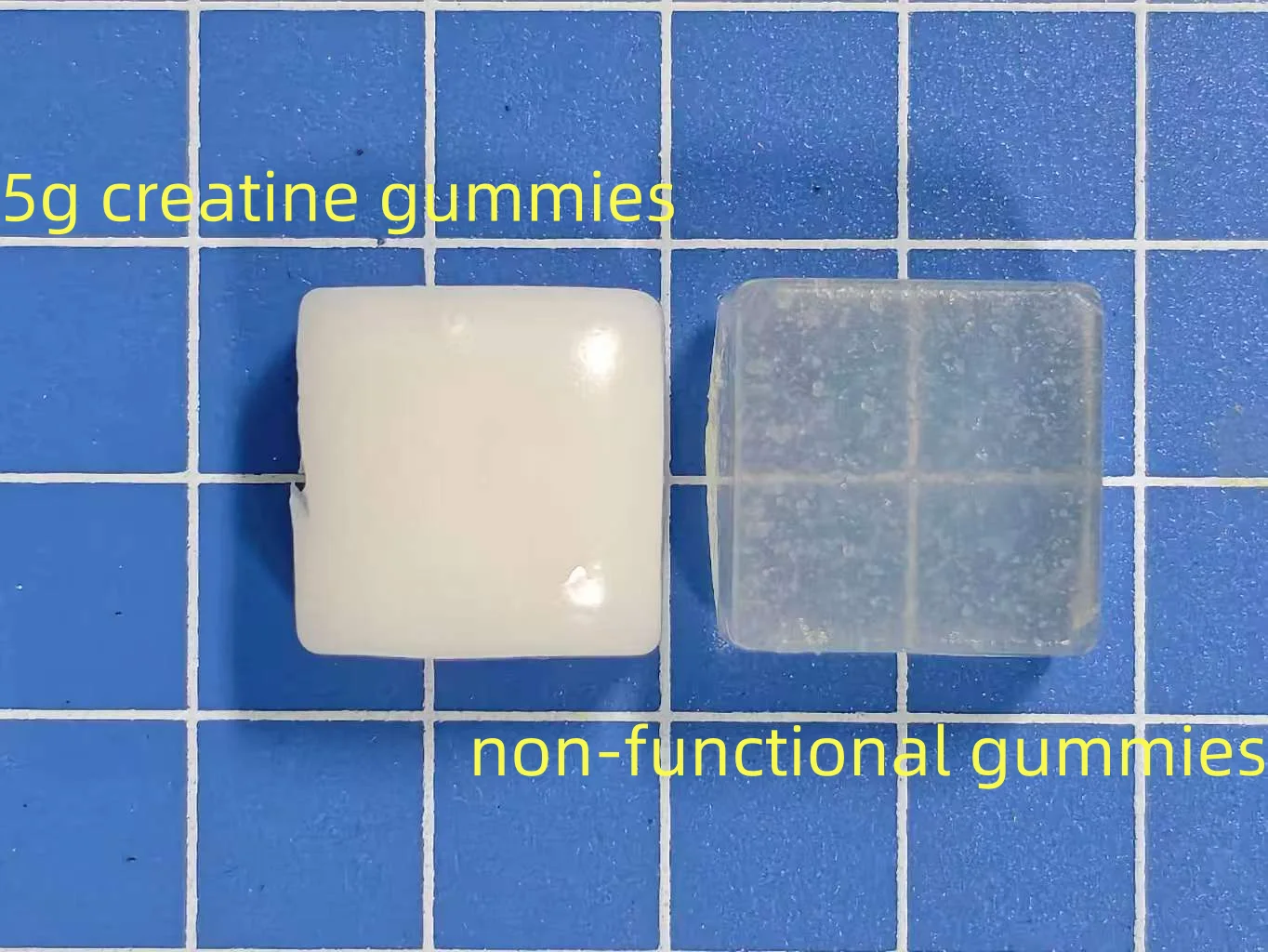
Some manufacturers show translucent or slightly transparent creatine gummy samples and describe them as high-content creatine gummies. High-content creatine gummies with a transparent appearance should be a warning sign.
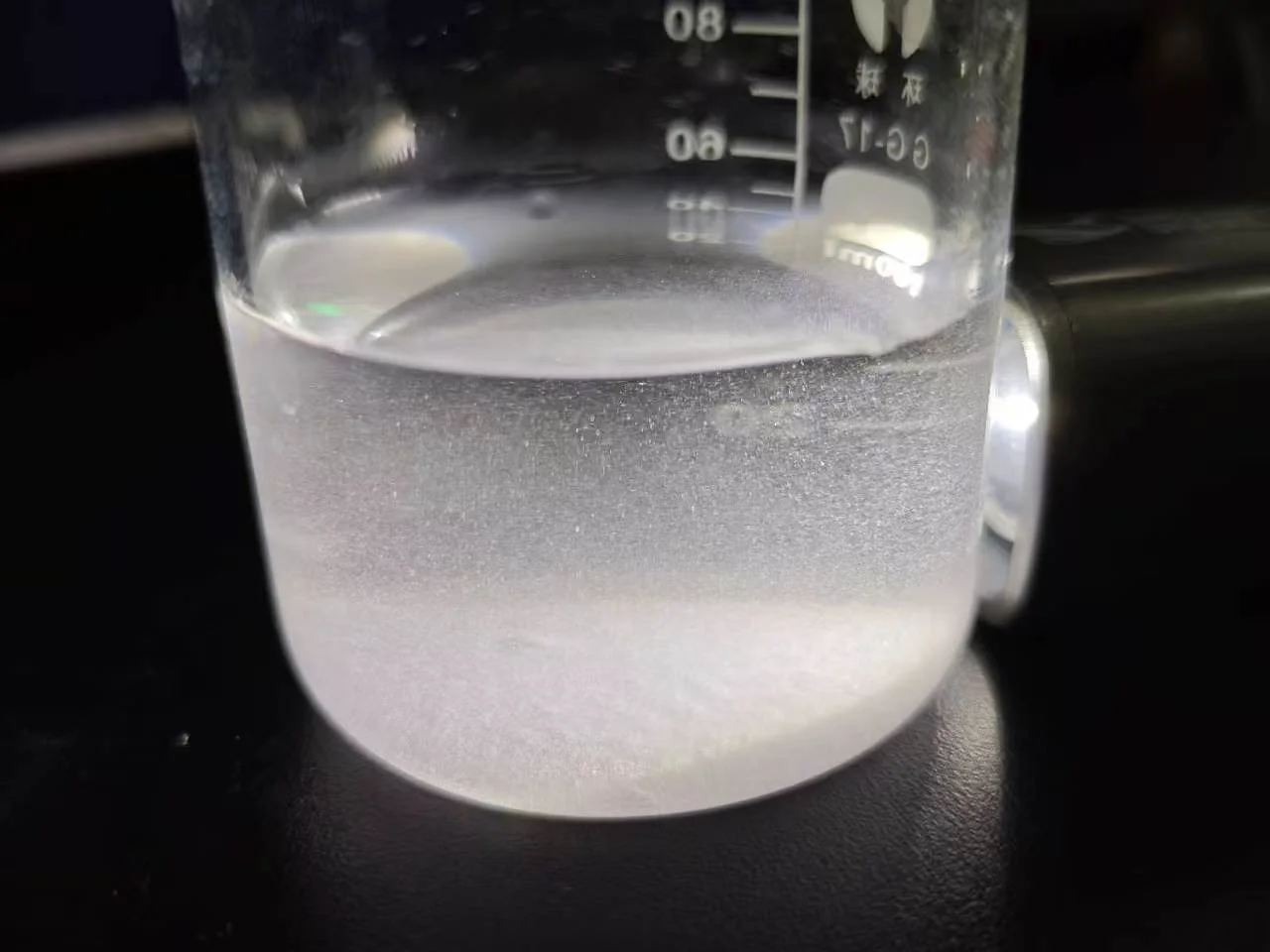
Creatine monohydrate has a solubility of about 14g/L in water at 20℃. The white creatine powder suspended in the syrup blocks light, making transparency difficult to achieve in the finished gummies.
As shown in the figure: 5g creatine gummies vs. non-functional gummies. The difference in appearance is clear.
Color Uniformity:
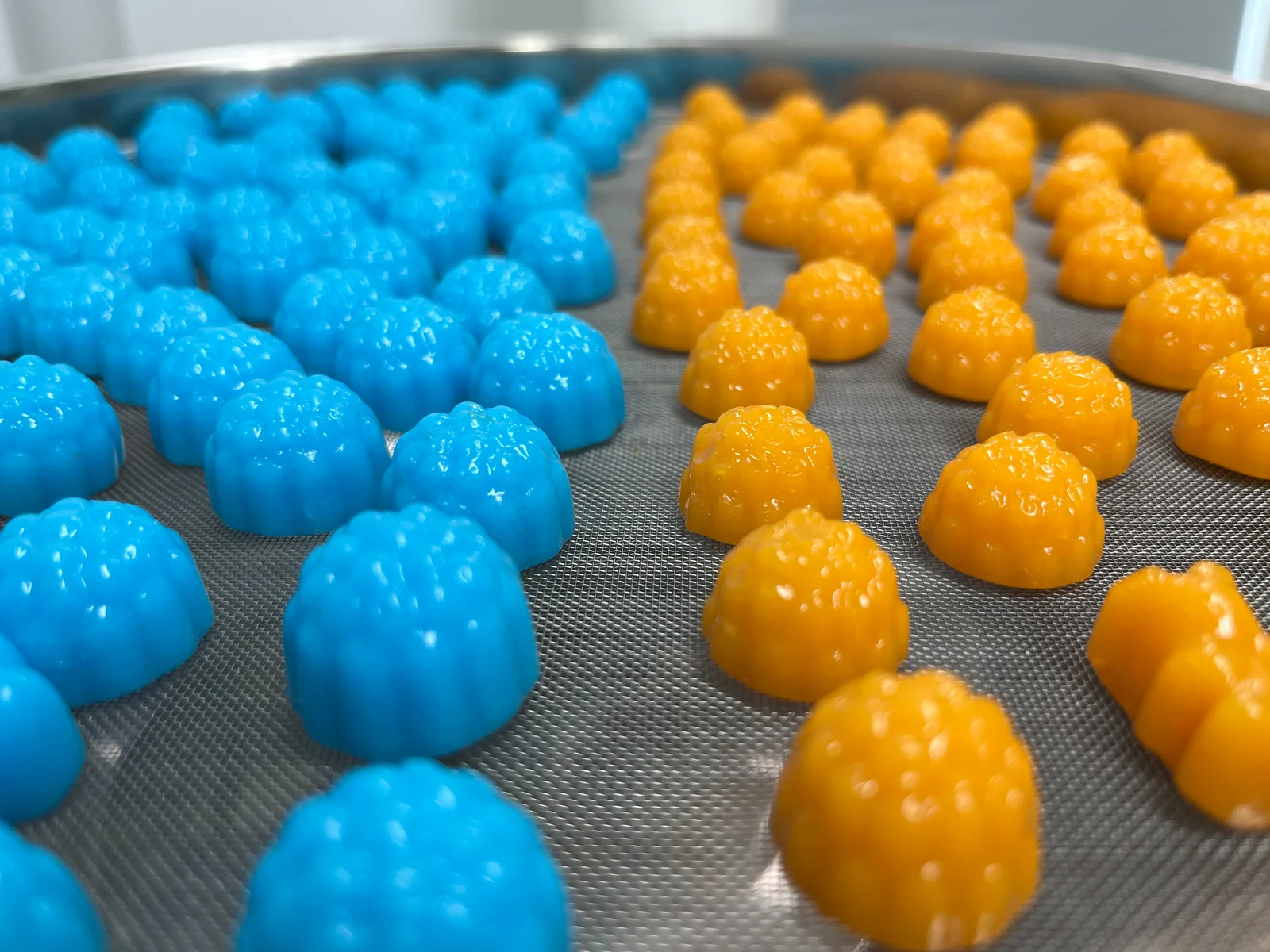
Creatine monohydrate is a white powder, so it allows considerable flexibility in color customization. Common examples include yellow mango creatine gummies and pink strawberry creatine gummies.
Because batch consistency matters for creatine gummies, a well-controlled homogenization process is essential to distribute creatine monohydrate evenly throughout every gummy. The colorants should also be evenly distributed.
Unless these effects are part of a special design, watch for color streaks, localized discoloration, or differences in color between gummies in the same bottle.
These are warning signs. Color streaks may result from insufficient homogenization or adding colorants too late, which can leave some gummies with too little creatine monohydrate.
Localized discoloration may result from unsuitable processing or storage conditions. Creatine monohydrate and colorants may undergo chemical changes under light and heat, causing discoloration. This is especially noticeable with natural colorants.
If two gummies in the same bottle differ in color, they may come from different batches. You can ask the supplier to trace the bottling and production batches.
Surface Smoothness:
Here, we are referring to the surface smoothness of freshly deposited creatine monohydrate gummies.
Different gummies can have similar surface smoothness after the same finishing treatment, such as powder coating, oiling, or surface hardening.
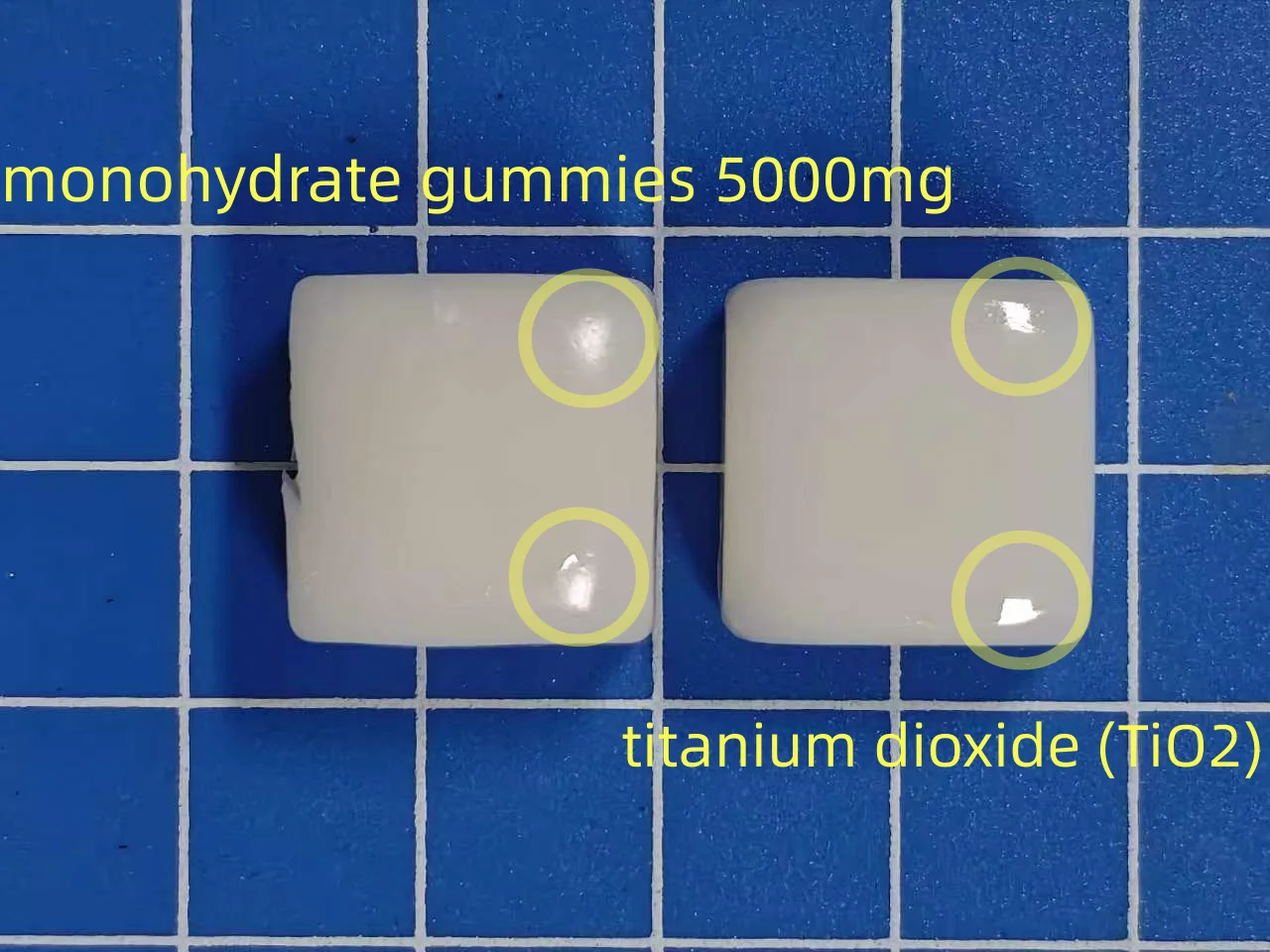
However, freshly deposited creatine monohydrate gummies can show subtle surface differences before finishing.
As the image shows, standard creatine monohydrate gummies 5000mg and regular gummies containing titanium dioxide (TiO2) as an opacifier.
The high creatine monohydrate content gives the gummies a slightly rough, matte surface.
The creatine monohydrate powder is evenly distributed throughout the gel network, giving the surface a powdery appearance. In contrast, the gel network in the titanium dioxide gummies is dense and uniform, creating a smooth surface.
Water Separation:
If the gummy surface looks noticeably wet after you have ruled out excess surface oil, this indicates water separation.
Possible causes include excessive moisture, problems with drying, or a formulation issue that releases water from the gel network.
Whatever the cause, water separation indicates a quality problem. Besides reflecting processing and ingredient loading issues, it can promote microbial growth and accelerate oxidation and spoilage. Gummies sticking together also affect your customers' experience.
Pay particular attention to this sign and ask the manufacturer about it. If necessary, use tightly sealed packaging to slow water separation.
Cracks:
Cracks can also occur in creatine gummy bears, especially at protruding parts such as the arms and legs.
Unsuitable drying parameters can cause the surface to harden too quickly. The thin, hardened surface of the creatine gummies may then crack after minor impacts or compression.
This points to problems with the manufacturer's processing parameters and transportation. Discuss whether they can resolve the issue to protect the product's appearance.
Texture Testing
This stage and all subsequent tests require the samples to have arrived.
Texture testing covers firmness, elasticity, chewiness, grittiness, powderiness, and residue in the mouth. The overall experience of tasting the product should usually guide the assessment.
Firmness tells you little about a gummy's quality, as it can be adjusted through the formulation and degree of drying.
When assessing elasticity in high-loading products such as high strength creatine gummies, the gummy's loading capacity is close to its limit. Creatine monohydrate powder fills the gel network, reducing its physical elasticity.
This directly reduces resilience and the gel network's ability to recover, which in turn affects chewiness. If the creatine monohydrate gummies you taste are notably springy, you may therefore need to examine them more closely.
Grittiness can arise when the creatine monohydrate powder is not milled finely enough or is mixed unevenly during processing. Large particles remain in the gummies, creating a gritty texture.
Powderiness and residue in the mouth are important criteria. It is difficult to remove powderiness completely from high-loading creatine monohydrate gummies. If you notice no powderiness while chewing or no powdery residue after swallowing, we recommend further verification.
These are sensory impressions and vary from person to person. You can taste the samples with colleagues from your brand to assess their texture and form a preliminary view of their quality.
If needed, you can then use professional equipment—a texture analyzer—for a more scientific, data-based assessment.
| Test | What to Observe | Sources of Variation |
|---|---|---|
| Firmness | Bite resistance Overall firmness |
Formulation differences Degree of drying |
| Elasticity and chewiness | Springiness Chewing resistance Breakdown during chewing |
Gel system Creatine loading |
| Grittiness | Graininess Localized roughness |
Raw material particle size Powder dispersion |
| Powderiness and mouth residue | Powderiness during chewing Residue after swallowing |
Effect on overall acceptance Content tested separately |
Flavor Testing
At this stage, focus on whether the samples have the taste of creatine monohydrate and whether there are any unusual or off-flavors.
Be alert to a possible issue: extremely strong flavoring may mask undesirable tastes or the absence of a creatine taste.
Creatine monohydrate has a distinctive, mildly sour and astringent taste, which some people describe as chalk-like.
During manufacturing, high-quality, finely milled creatine monohydrate is used to reduce this undesirable taste. Suitable flavorings, such as rich mango or blueberry flavors, are then used to balance it.
However, the distinctive taste of creatine monohydrate remains.
An extremely strong flavoring taste or slight sourness caused by microbial fermentation should be treated as a quality issue. Even if the creatine content meets the target, the product's shelf-life stability may be affected.
Content Testing
The sensory checks above can support a quick assessment, but they remain supporting methods. The test report provides the core evidence. From this stage onward, scientific physical and chemical testing is needed.
Creatine monohydrate content remains the priority. Most brands want their gummies to provide the recommended intake of 5g of creatine monohydrate per serving. This is also a standard test item in many product reviews.
You can ask the manufacturer for a test report, then test the samples yourself or commission an independent laboratory to retest them.
Compare the creatine gummies test results in the reports and keep copies for your records. Products described as third party tested creatine gummies often receive greater market recognition.
Creatine Content Testing:
Brands may overlook an important distinction. What we commonly call creatine is, more precisely, its hydrated form: creatine monohydrate. Creatine accounts for about 87.9% of the mass of creatine monohydrate.
The typical daily supplementation protocol of 3-5g in NIH technical guidance also refers to creatine monohydrate and explicitly uses an 88% creatine-by-mass basis. Manufacturers also usually set their content specifications in terms of creatine monohydrate.
Content testing, however, commonly uses high-performance liquid chromatography (HPLC-UV), which measures creatine rather than creatine monohydrate. Conversion between the two usually uses a factor of 0.879.
If the manufacturer's creatine gummies supplement facts label states 5g of creatine per serving but retesting finds less than 5g per serving, explain that the project's target is creatine content, not creatine monohydrate content. In this case, each serving of gummies should provide 5.69g of creatine monohydrate.
Creatinine Content Testing:
Creatinine is usually tested alongside creatine. It is a breakdown product formed from creatine under high temperatures and acidic conditions and cannot be used by the body. Its formation also reduces the gummies' creatine content.
This reflects how well the product is suited to the manufacturing process. Excessive creatinine levels usually indicate insufficient control over processing conditions.
This affects both the target creatine content and creatine stability in gummies.
If creatine content meets the specification but creatinine is also noticeably elevated, the manufacturer may be relying on overages. Even if the product passes the content test, this can affect its creatine content later in its shelf life.
Moisture Testing:
Moisture content usually reflects the gummies' post-processing condition. Freshly deposited and set gummies are not yet ready for packaging, as doing so can shorten shelf life and cause sticking.
They therefore need to be dried to reduce their overall moisture content. In general, the moisture content should be kept at 18-22%.
You can commission a third-party laboratory to perform this test and assess the gummies based on the results.
If moisture content is too low, the gummies become noticeably harder and drier, affecting their texture. Ask the supplier to adjust the process and send improved samples.
If moisture content is too high, the gummies become softer and may deform under compression during transportation. Excessive moisture can also shorten shelf life, accelerate changes such as the oxidation of additives, and promote microbial growth.
Sugar Content Testing
This test is particularly relevant to sugar free creatine gummies. Maltitol or erythritol replaces the sucrose in the formulation to make the gummies sugar-free.
However, changing the sweetening ingredient alone is not enough to support a sugar-free label claim. You also need to check the other creatine gummies ingredients for added sugars.
After submitting samples for testing, focus on total sugar content. If the result is not 0 but is low—for example, less than 0.5g/100g—you can still apply for sugar-free certification after checking the regulations in your project's target market.
A simple substitution can also cause quality problems, such as gummies failing to set or sugar recrystallization.
Even if the sugar content report supports sugar-free certification, we therefore recommend discussing the formulation with the manufacturer, whether it could cause shelf-life problems, and whether a stability report is available to support it.
Reliable Creatine Gummies: Stability Testing Is Essential
The tests above generally allow us to identify candidate samples of lab tested creatine gummies that have the stated ingredient content, offer excellent texture, and meet label and regulatory requirements.
However, buyers can easily overlook one point: a commercial creatine gummy project spans development, manufacturing, inventory, and sales.
We cannot precisely predict performance in the latter part of shelf life, but stability testing can provide a preliminary assessment and greater confidence in your project. We therefore consider it essential.
Stability Testing
Specifically, creatine gummy samples are placed in a controlled environment. For example, Sucotond's internal conditions are a constant 40°C and 75% relative humidity.
Creatine gummies from multiple batches are stored in equipment that maintains these conditions. Creatine, creatinine, and other parameters are tested at several time points over a total of 90 days.
This cannot be completed during early project screening. You can, however, request historical product stability reports from the manufacturer to guide your assessment.
Once the project has been approved and manufacturing has started, dedicated testing can be carried out for your project. This has important commercial value for a long-term project.
Our usual test parameters are shown in the table below:
| Item | Setting / Content | Notes |
|---|---|---|
| Product | Creatine gummies | High-loading functional gummy system |
| Accelerated conditions | 40℃±2℃ / 75%±2%RH | Accelerated observation under high temperature and humidity |
| Observation time points | 0 days, 7 days, 14 days, 21 days, 1 month, 2 months, 3 months | Up to 90 days |
| Tests | Creatine, creatinine, creatine monohydrate | Content, degradation marker, and converted value |
| Conversion formula | Creatine monohydrate = creatine × 1.137 | Align label and test reporting bases |
| Purpose | Assess content retention, creatinine formation, and overall stability risks under high temperature and humidity | Guide formulation, processing, and packaging |
This test simulates a relatively complete project cycle and can help assess the gummies' performance over their 24-month shelf life to some extent. It can also include the other tests mentioned above, helping you select more reliable products and suppliers.
Below are results from one of our historical stability test reports, so you can see more clearly what this test shows and how it can help your project.
| Batch | time | day | Creatine (%) | Creatinine (%) | Creatine Monohydrate (%) | Retention (%) |
|---|---|---|---|---|---|---|
| 25061801 | 0D | 0 | 27.986 | 0.895 | 31.820 | 100.0 |
| 25061801 | 7D | 7 | 27.226 | 1.416 | 30.956 | 97.3 |
| 25061801 | 14D | 14 | 29.310 | 1.565 | 33.325 | 104.7 |
| 25061801 | 21D | 21 | 29.360 | 1.700 | 33.382 | 104.9 |
| 25061801 | 1M | 30 | 29.270 | 1.820 | 33.280 | 104.6 |
| 25061801 | 2M | 60 | 26.100 | 1.610 | 29.676 | 93.3 |
| 25061801 | 3M | 90 | 25.510 | 1.610 | 29.005 | 91.2 |
| 25063001 | 0D | 0 | 34.538 | 0.669 | 39.270 | 100.0 |
| 25063001 | 7D | 7 | 33.965 | 1.300 | 38.618 | 98.3 |
| 25063001 | 14D | 14 | 35.115 | 1.630 | 39.926 | 101.7 |
| 25063001 | 21D | 21 | 31.105 | 1.690 | 35.366 | 90.1 |
| 25063001 | 1M | 30 | 29.635 | 1.685 | 33.695 | 85.8 |
| 25063001 | 2M | 60 | 31.770 | 1.540 | 36.122 | 92.0 |
| 25063001 | 3M | 90 | 35.625 | 1.705 | 40.506 | 103.1 |
| 25070801 | 0D | 0 | 35.840 | 0.450 | 40.750 | 100.0 |
| 25070801 | 7D | 7 | 38.900 | 1.265 | 44.229 | 108.5 |
| 25070801 | 14D | 14 | 33.750 | 1.435 | 38.374 | 94.2 |
| 25070801 | 21D | 21 | 33.430 | 1.815 | 38.010 | 93.3 |
| 25070801 | 1M | 30 | 31.110 | 1.230 | 35.372 | 86.8 |
| 25070801 | 2M | 60 | 33.995 | 1.600 | 38.652 | 94.9 |
| 25070801 | 3M | 90 | 35.010 | 1.550 | 39.806 | 97.7 |
What to Look for in Creatine Gummies?
To select high-quality creatine monohydrate gummies for your project, follow this sequence: website review, video call, sample inspection, tasting, laboratory testing, and stability testing.
| Website Review | Video Call (Visual Review of Shipped Samples) | Taste Test | Laboratory Sample Testing | Stability Testing |
|---|---|---|---|---|
| Unclear content labeling | Deformed shape | Excessive chewiness | Insufficient creatine content Incorrect conversion basis |
Historical data not applicable Missing packaging data |
| Inconsistent amounts per serving and per gummy | Clarity differs from the target | Noticeable grittiness Unacceptable powdery mouthfeel and residue |
Elevated creatinine levels | Rapid decline in creatine content Rapid increase in creatinine content |
| Loading below the project target | Streaks and localized color differences Color differences between gummies in the same bottle |
Unusual sourness, astringency, or off-flavors | Moisture content outside specifications | Abnormal physical or chemical test results |
| Specifications do not match requirements | Abnormal surface texture (during depositing) Obvious water separation, cracks, and sticking |
Noticeable masking by added flavoring | Sugar content does not match claims | Texture deterioration |
FAQ
1.What are some common lab tested creatine gummies, in your opinion?
Products described as nsf certified creatine gummies generally receive greater recognition. However, note that this refers to the test results for a specific batch of creatine gummies submitted for testing. It is not certification of this type of product or of the entire manufacturing plant.
Specifically, this is NSF/ANSI 173 product certification. Ask the manufacturer to confirm the identification number so you do not confuse it with NSF/ANSI 455-2 GMP certification of the manufacturing plant.
Another commonly recognized third-party testing option is eurofins creatine gummies.
2.For my project, how do I choose the best creatine gummies for daily performance?
For a creatine gummy application such as Daily Creatine Gummies, designed for daily use, I recommend focusing on flavor and texture.
Creatine gummies are positioned more as a snack, so poor flavor may discourage your customers from taking them daily over the long term.
Grittiness, sourness, astringency, and off-flavors should therefore be key defects to check.
3.What should I look for when choosing the best pre-workout gummies for my project?
You can focus on combination formulations. For creatine gummies pre workout, creatine gummies with electrolytes are a common option for replacing minerals lost during exercise.
Ingredient levels also deserve attention. Adding other ingredients may affect the gummies' loading capacity and cause texture problems. The creatine monohydrate amount may therefore be reduced to 4g or 3g per serving to balance processing costs.
Creatine Electrolyte Gummies are usually designed this way. Discuss with the manufacturer whether a reduced-dose design is acceptable for your project.
4.What are the key special considerations for my Creatine HCl Gummies project?
Creatine hydrochloride is another form of creatine, with a creatine mass fraction of 78%, compared with 88% for creatine monohydrate. Its higher solubility makes it an option for product differentiation.
As a result, creatine hydrochloride gummies can be slightly transparent, with much less powderiness. The appearance test described in this article therefore no longer applies to your project.
However, this ingredient absorbs moisture readily, making the gummies more prone to water separation. You can discuss more tightly sealed jars with the manufacturer.
5.What do you think are the benefits of using creatine gluconate over other forms of creatine?
The main advantage of creatine gluconate is its flavor. Its solubility lies between that of creatine monohydrate and creatine hydrochloride. It reduces the pronounced sourness and astringency of creatine monohydrate without the strong sour taste of creatine hydrochloride, giving it the mildest flavor.
Its drawback is also clear: creatine accounts for 40% of its mass, less than half the proportion in creatine monohydrate. This makes it difficult to deliver a high creatine dose in a small number of gummies.
However, it remains an excellent option for developing a basic creatine gummy product.
Final Thoughts
Overall, we recommend looking beyond creatine monohydrate content testing alone.
Using a wider range of tests at the right time can help you screen projects more efficiently and accurately while improving the creatine gummy experience.
If you have a project in mind or would like to know more about any of these tests, please contact Sucotond